
Register of Wills and Orphans' Court
Maryland splits estate work between two offices. The Register of Wills is the filing and records office. It handles wills, petitions for probate, inheritance tax, and the day-to-day estate paperwork. The Orphans' Court is the judicial body that resolves probate disputes and oversees estate administration. In Montgomery County, both operate out of the Rockville court campus.
The Montgomery County Register of Wills official page is the local starting point. It is shown below.
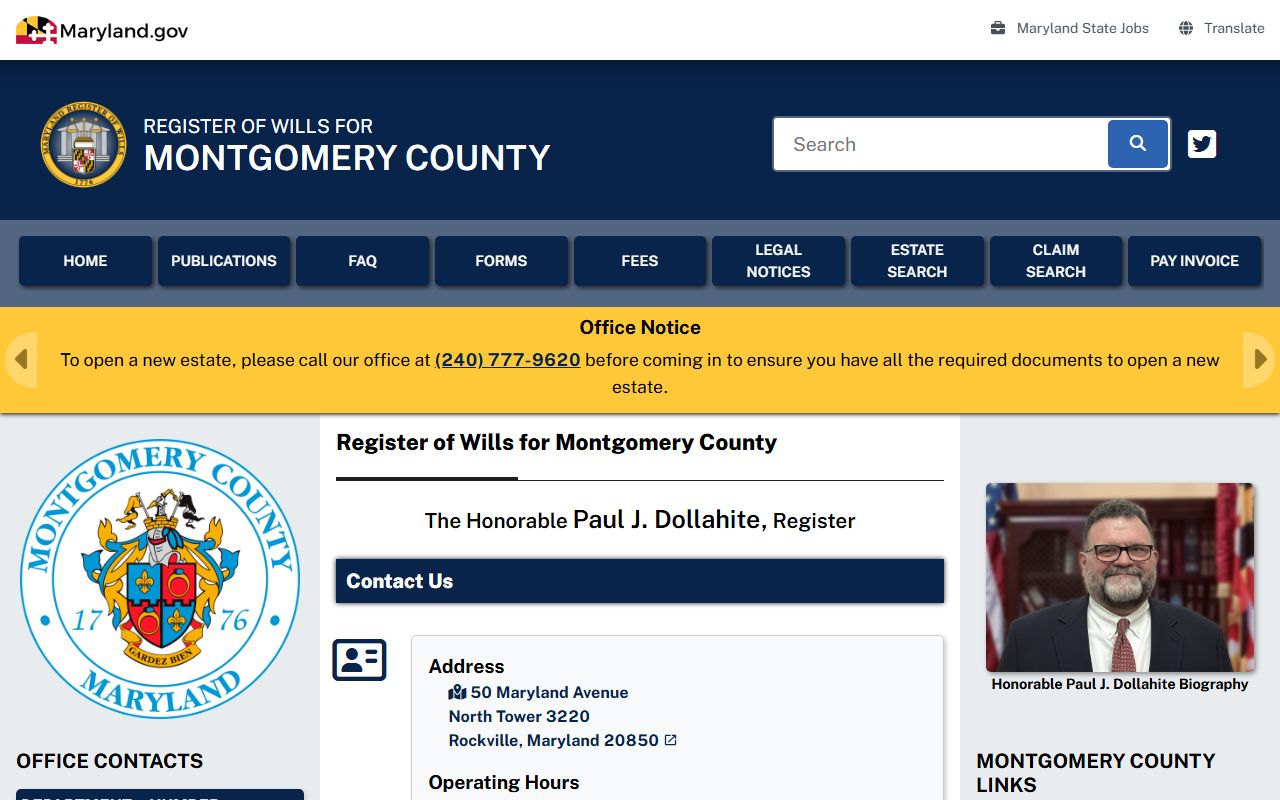
Visit the Montgomery County Register of Wills page for office contact and current information. Keeping the two roles straight helps: the Register is where you file and request records, and the Orphans' Court is where a judge decides contested issues.
How to Search Montgomery County Estate Records
The public starting point is the Maryland Register of Wills Estate Search. It is a free statewide portal that locates estate files by county and decedent name. Select Montgomery County to narrow results to local estates. The Estate Search page is shown below.
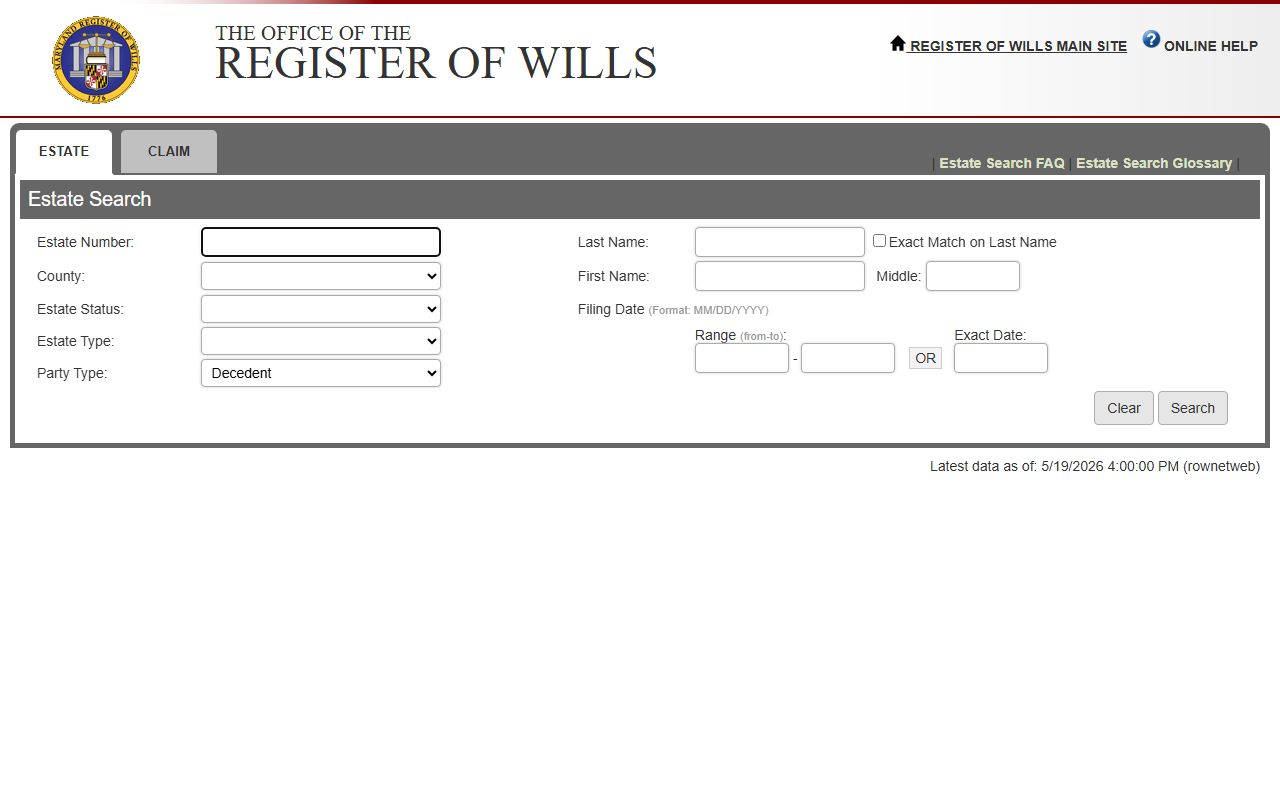
- Open the Estate Search portal.
- Select Montgomery County.
- Enter the decedent's last name, or an estate number if known.
- Review the results and note the estate number.
- Order copies through the Register of Wills if you need full documents.
The search fields are listed in the table below.
| Field | Type | Required | Notes |
|---|---|---|---|
| County | Dropdown | Recommended | Select Montgomery County for local estates. |
| Decedent Last Name | Text | Conditional | Most common search path. |
| Decedent First Name | Text | No | Narrows the search. |
| Estate Number | Text | Conditional | Direct lookup if known. |
What Probate Records Cover
Probate is the process of administering a deceased person's estate. The records document who manages the estate, what it holds, and how it is distributed. Public access to estate files is generally broader than for family or juvenile records, though some personal and financial details may be limited or not available remotely. The Estate Search index is the fastest way to confirm an estate exists and to capture its estate number.
A probate file may include the following items.
- The will and any codicils.
- The petition for probate and list of interested persons.
- Bonds and notices to creditors.
- Inventories and administration accounts.
- Claims, orders, distributions, and inheritance tax filings.
Statewide forms for these filings are posted by the Register of Wills, shown below.
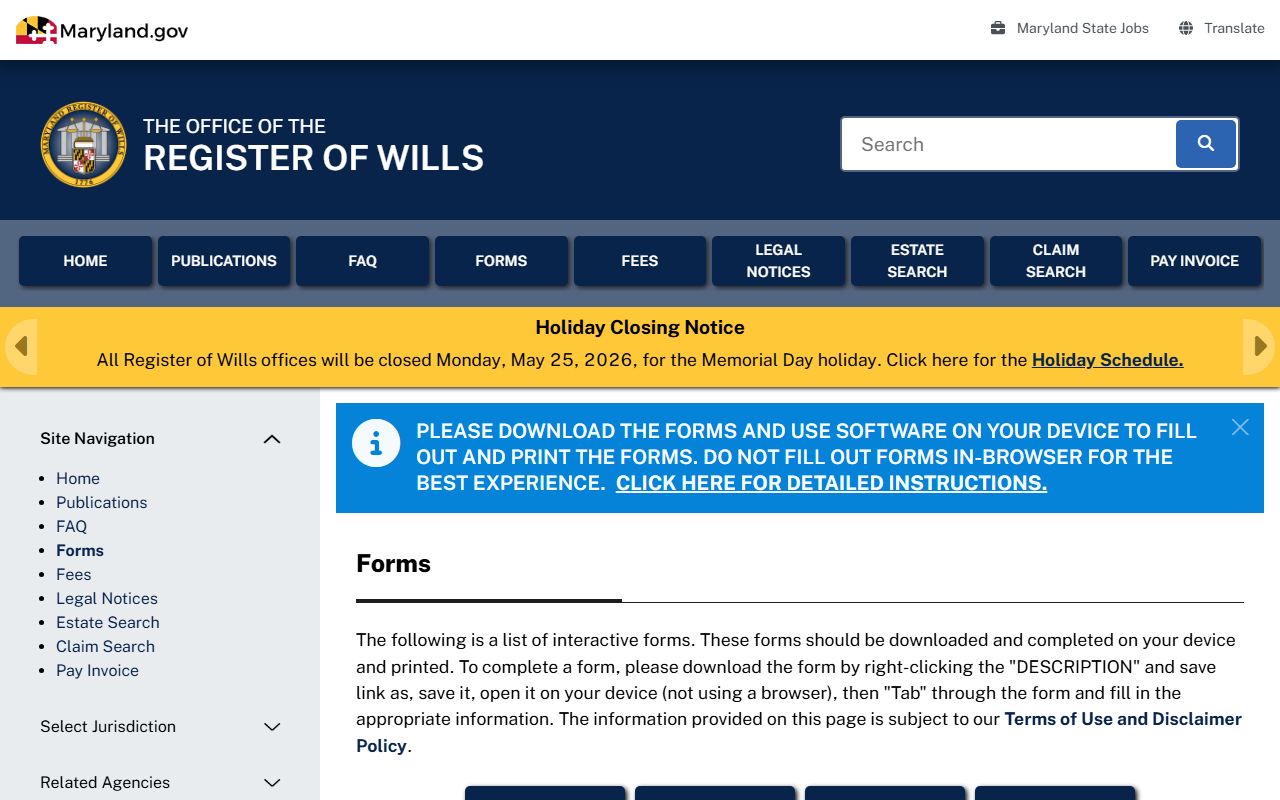
The Register of Wills forms page covers small estate and regular estate filings statewide.
Probate Terms Defined
Probate has its own vocabulary, and a few terms come up in almost every estate. Knowing them makes a file far easier to read.
- Testator
- The person who made the will.
- Executor
- The person named to carry out the will, also called a personal representative.
- Intestate
- Dying without a valid will, so state law decides who inherits.
- Letters of Administration
- The document authorizing a representative to act for an estate.
- Guardianship
- A court arrangement for the care of a person or their affairs.
- Conservatorship
- Management of another person's property or finances by court order.
Estate Administration Steps
Administering an estate follows a set order in Maryland. Whether an estate is small or regular depends on its value under state thresholds, and that choice shapes the paperwork. The basic path runs like this.
- Determine whether the estate is small or regular under Maryland thresholds.
- Locate the original will, if one exists.
- File the required petition and forms with the Register of Wills.
- Have the personal representative appointed and letters issued.
- Give notice to interested persons and creditors.
- File the inventory and any required accounting.
- Pay claims, taxes, and expenses, then distribute the remaining assets.
The Orphans' Court steps in when there is a dispute or a matter that needs a judge. Common disputes include challenges to a will, disagreements among heirs, and questions about how a personal representative handled the estate. Most estates, though, move through the Register of Wills without ever needing the court.
Inheritance tax is part of the picture in Maryland. It applies to certain heirs based on their relationship to the person who died, and the Register of Wills handles the related filings. Whether tax is owed depends on who inherits, so confirm the current rules through the Register before assuming an estate owes nothing.
Small vs Regular Estates
Maryland sorts estates into two tracks based on value. A small estate uses a simpler, faster process with fewer filings. A regular estate involves more steps, more notice, and usually formal accountings. The value threshold that separates them is set by state law, so confirm the current figure with the Register of Wills before you choose a track.
| Feature | Small Estate | Regular Estate |
|---|---|---|
| Process | Simplified, fewer forms | Full administration |
| Accounting | Limited | Formal inventory and accounts |
| Typical use | Lower-value estates | Higher-value or contested estates |
The Register of Wills can tell you which track fits a given estate, since the choice affects the forms and fees that follow. Picking the right track early saves time and avoids refiling later.
Guardianship and Restricted Records
Not every probate matter is a death estate. The court system also handles guardianship of a person or property and conservatorship arrangements. These protect people who cannot manage their own affairs, and they create their own records.
Access can be more limited here. Files involving minors, medical information, or finances may be redacted or restricted, even within the broader public probate system. Where a record is sealed, viewing it generally requires a court order. For the rules behind restricted court records in general, the court records page explains how Maryland limits access.
Note: probate files are generally more open than family or juvenile files, but specific financial and personal details can still be withheld.
Probate Fees and Certified Copies
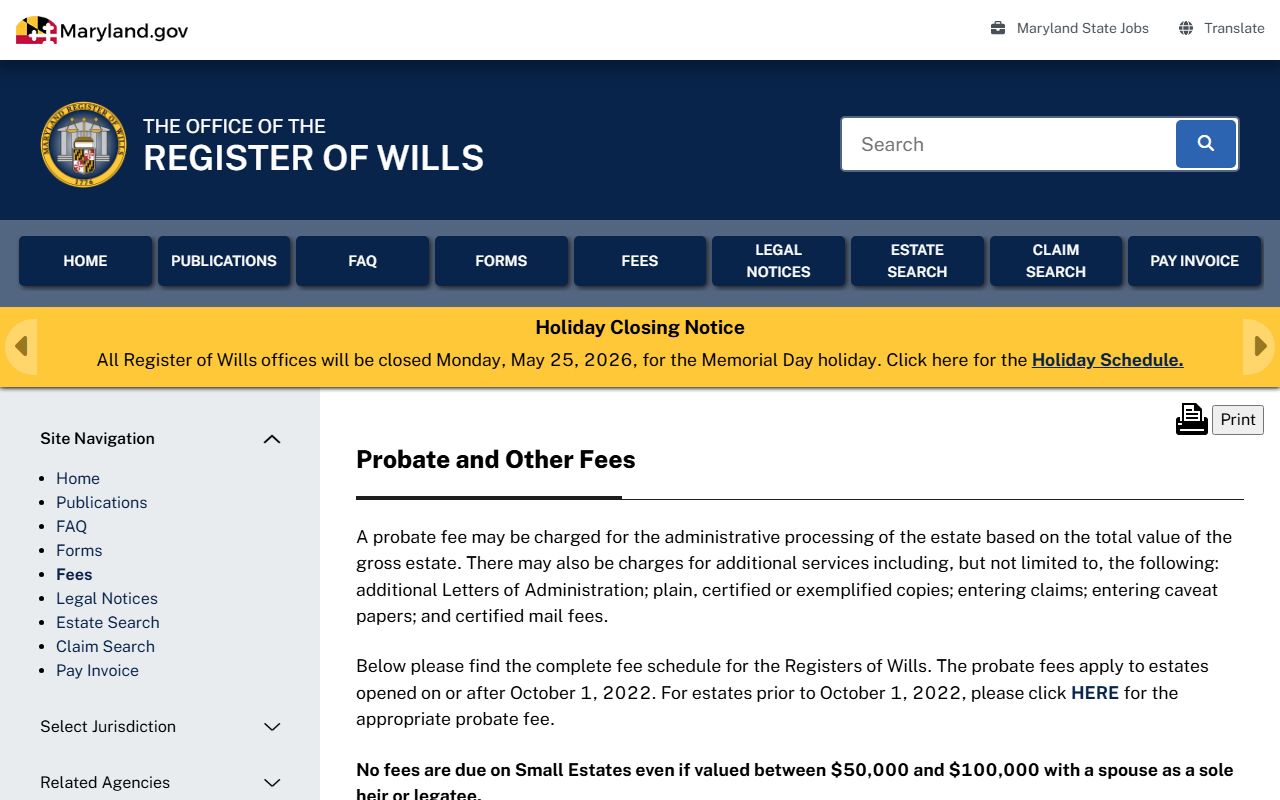
Estate fees in Maryland are set by statute and are commonly based on the value of the estate. Because the exact amounts are set on the official schedule and can change, confirm them on the Register of Wills fee page rather than relying on a fixed figure. The fee page is shown below.
| Item | How It Is Set |
|---|---|
| Probate fee | Based on estate value, set by statute |
| Certified copies | Per-document charge set by the Register |
| Inheritance tax | Applies to certain heirs under Maryland law |
Confirm current amounts on the Register of Wills fee schedule. Certified copies and full estate files are requested through the Register of Wills. As with court files, the index in Estate Search is free, but ordering complete documents or certified copies carries a charge and may take time for older estates.